

Efficacy of Vegesol eReS in Grapevine Treatments
In vineyards, repeated applications of Vegesol eReS during the growing season can provide effective control against both powdery mildew and downy mildew, the two pathogens capable of causing the most significant damage.
Although grapevine powdery mildew is most commonly observed on grape bunches, its first symptoms can usually be detected on the leaves. If sufficient overwintering inoculum is present and infection occurs early, shortly after bud break, epidemic development may follow. The formation of overwintering structures should therefore be prevented as early as late summer. Chasmothecia forming in August and September can be effectively reduced with oil-formulated sulfur while they are still immature (yellow or brown). Taking the timing of harvest into consideration, Vegesol eReS can also be effective for this purpose. In spring, once the first symptoms are detected, successful control can again be achieved with a contact active substance, making Vegesol eReS a suitable choice at this stage as well.
During periods of intensive shoot growth in grapevines, contact products may provide adequate control when applied at shorter spray intervals (maximum 7 days), while applications can also be adjusted according to weather conditions. The strength of Vegesol eReS lies in its patented formulation: thanks to its special plant oil content, wash-off is slowed down, meaning that only a small proportion of the active substances is removed from the plant surface by morning dew or rainfall. This characteristic – its excellent rainfastness – distinguishes it from competing products.
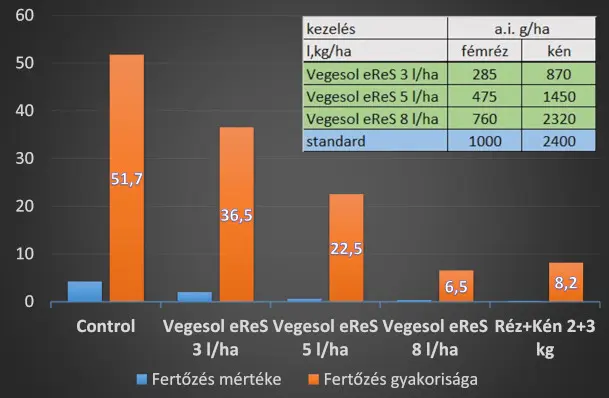
Figure 1. Efficacy of Vegesol eReS against grapevine powdery mildew based on symptom severity and incidence following three spring treatments, evaluated on leaf symptoms (early June assessment, 2017, Romania)
Rainfastness is also clearly demonstrated in our biological efficacy trials, as this characteristic makes it possible to achieve the same biological efficacy with significantly less active substance than competing products (Figure 1).
Application rates above the authorized rate are required for phytotoxicity testing; even at the highest rate tested, no phytotoxicity was observed in grapevines. Nevertheless, applications should always be carried out with care, and treatment should not be performed at air temperatures above 25 °C.
Epidemic outbreaks of grapevine downy mildew occur less frequently, as disease development depends not only on the quantity of inoculum produced during the previous growing season and its ability to overwinter, but also on favourable weather conditions occurring while grape bunches are susceptible.
The most important source of downy mildew infection is infected leaf debris. If spring night-time temperatures remain above 10 °C and at least 10 mm of rainfall occurs, the overwintering spores begin to develop and reach the leaves closest to the soil, where they form germ tubes and penetrate through the stomata. Depending on the temperature-dependent incubation period, the first symptoms may appear within 1–2 weeks. Large quantities of downy mildew inoculum may also arrive with summer weather fronts.
Crop protection measures should prevent germinating spores from penetrating the leaf blade. If the spores encounter a fungicide on the plant surface, penetration can be prevented before infection becomes established, eliminating the need to subsequently inhibit sporulation in oil spots with a systemic product. Thanks to the excellent rainfastness of Vegesol eReS, the product remains on the plant surface for an extended period and protects the crop against downy mildew infection. Because wet weather is essential for downy mildew germination, rainfastness should be an important consideration when selecting a product under such conditions.
The formulation advantage of Vegesol eReS makes it possible to achieve the same biological efficacy using significantly less active substance than competing products (Figure 2). Consequently, treatment with the product places a lower metallic copper load on the vineyard, while the permitted copper limit of 4 kg/ha is only reached after repeated applications (8×).
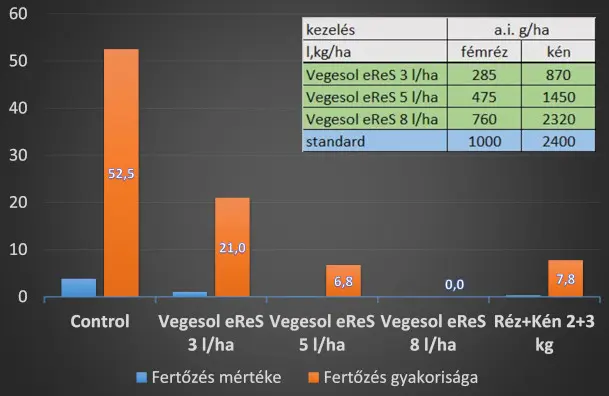
Figure 2. Efficacy of Vegesol eReS against grapevine downy mildew based on symptom severity and incidence following three spring treatments, evaluated on leaf symptoms (early June assessment, 2017, Romania)
Based on the results of numerous efficacy trials, we can confidently state that the sulfur content of Vegesol eReS also contributes to its efficacy against downy mildew: sulfur acts as a synergist, enhancing the overall effect against the disease.