

How to Achieve Long-Lasting, Rainfast Contact Treatment
A unique combination of copper and sulfur in crop protection.
Dormant-season fungicide treatments need to contain multiple active substances in order to provide effective control against a wide range of pathogens. As a result of the development work carried out by BVN Növényvédő Kft., Vegesol eReS combines copper hydroxide and sulfur in a ready-to-use formulation containing plant oil, which provides outstanding adhesion of both fungicidal active substances.
The combination of copper and sulfur gives the product a broad spectrum of activity against various fungal pathogens, while the oil-based formulation, together with its additives, forms a slowly degrading film on the plant surface, ensuring long-lasting biological efficacy of the active substances. This patented technology makes BVN products unique, including the Vegesol eReS fungicide. This explains why Vegesol eReS provides excellent biological efficacy against downy mildew-type pathogens even with a lower copper load, and this efficacy-enhancing property also applies to sulfur. It is also worth noting that sulfur is not only effective against powdery mildew-type fungi, but also has a significant suppressive effect on mites.
When Should Vegesol eReS Be Used?
Autumn and spring dormant-season spraying should be a fundamental part of crop protection in orchards and plantations. Harmful organisms that occur during the growing season – including pathogenic fungi, bacteria and, of course, animal pests – remain present in our plantations during winter. To minimise their populations and reduce subsequent damage, dormant-season spraying with Vegesol eReS should be carried out in autumn at leaf fall and again at the end of winter or in early spring at bud break, before the petals begin to open.
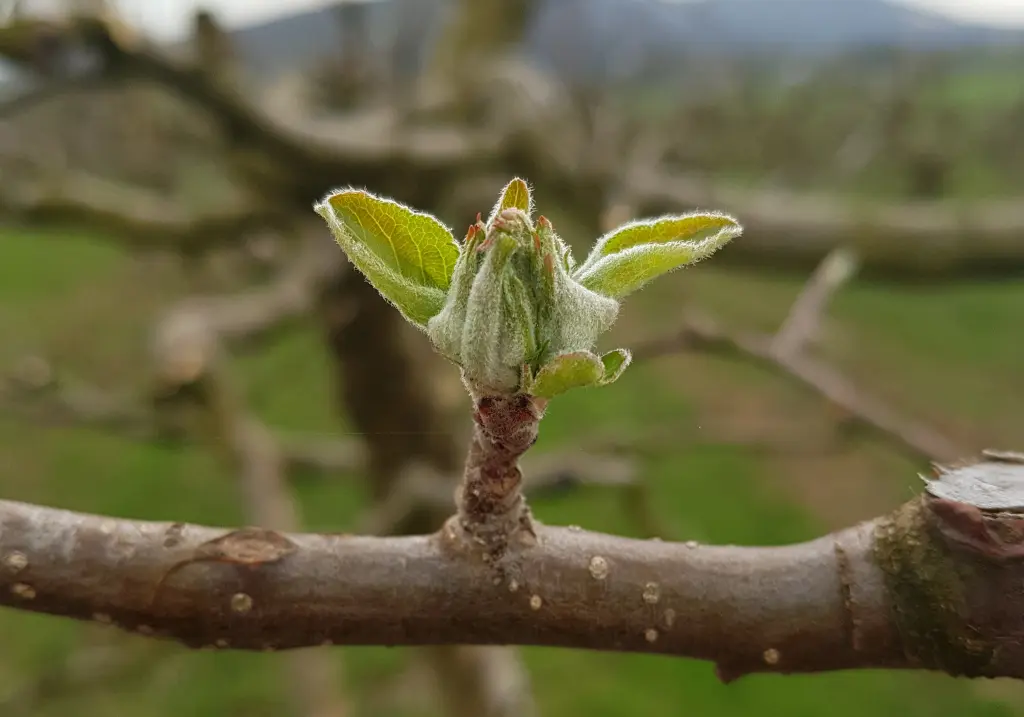
Optimal stage for treatment – photo: BVN Növényvédő Kft.
More Than a Dormant-Season Spray!
As a result of the successive withdrawal of active substances in recent years, the remaining contact fungicidal active substances have become increasingly important. Consequently, the role of copper and sulfur has also grown in crop protection programmes during the growing season. The main disadvantage of contact plant protection products has traditionally been their relatively short residual activity, which can be reduced by rainfall, wind and intense sunlight.
The durable film layer formed by the oil-based formulation of Vegesol eReS helps overcome this limitation. Longer-lasting activity means fewer spray applications, allowing crops to be protected with a lower environmental impact. In addition, the oil-based formulation significantly reduces spray drift.
Approved for use in pome fruits, stone fruits, berry crops and outdoor cucumbers. For exact and detailed conditions of use, always consult the product label, the official authorization document and the bvn.hu website.
The copper sensitivity of certain varieties must be taken into account, and spraying should not be carried out at temperatures above 25 °C. For summer use in home gardens, mix 50 ml of the product into 10 L of spray solution; for dormant-season spraying, use 100 ml per 10 L of spray solution.
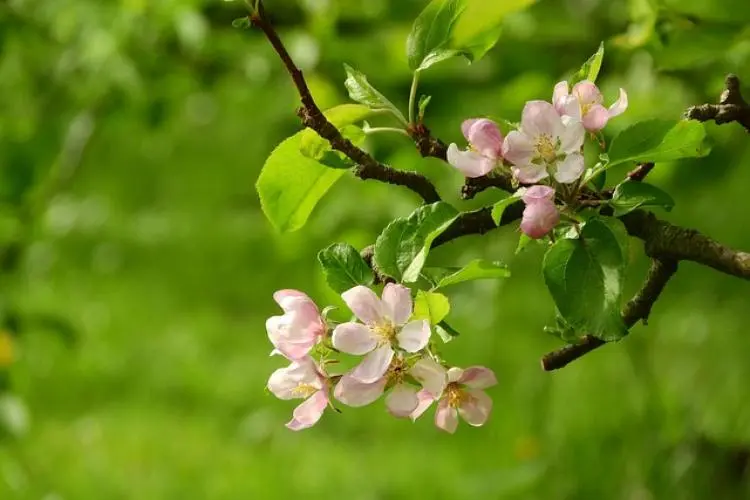
Autumn and spring dormant-season spraying should be a fundamental part of crop protection in orchards and plantations – photo: pixabay.com
Vegesol eReS for the Protection of Apple Orchards During the Growing Season
The two most common and important diseases in apple orchards are apple scab and powdery mildew. Controlling the pathogens responsible for these diseases requires regular crop protection measures throughout almost the entire growing season. Apple varieties differ in their susceptibility, but all are affected to some degree, which means that control is generally based on chemical treatments. Fortunately, a wide range of highly effective products is available against both pathogens, although their use sometimes requires considerable expertise in order to prevent the development of resistance.
Vegesol eReS is a fungicide used primarily as an autumn and spring dormant-season spray in a wide range of crops. However, the product can also be applied during the growing season, as its special plant oil content serves only to improve adhesion and, at the authorized application rate, does not cause harmful effects on green plant tissues (phytotoxicity).
The timing for starting apple scab control can be determined using weather parameters monitored in the orchard. Depending on the beginning of ascospore release and the weather conditions required for infection, effective control most commonly begins before flowering. Cool spring weather and prolonged leaf wetness limit the range of active substances that can be used successfully. Copper remains a highly reliable option under these conditions because even very small quantities of this active substance can destroy germinating ascospores, and resistance to copper does not develop. The challenge when using copper is that, as a contact active substance, it must be present on the plant surface precisely when and where the fungus germinates.
This is where Vegesol eReS delivers outstanding performance compared with competing combinations. Due to its sunflower oil content, the sprayed film polymerizes, forming a cross-linked layer on the plant surface that is not easily washed off. Consequently, even heavier rainfall or morning dew does not readily remove the copper active substance from the leaves, allowing it to remain present precisely when and where fungal germination occurs.
This patented technology is unique on the Hungarian plant protection product market.
The demonstration trials presented here were conducted in 2017 under a GEP quality assurance system. The first treatment was applied at bud break, the second at mouse-ear stage and the third at green bud stage. Evaluation was carried out at flowering, by which time significant differences between the plots were already apparent. The trial was conducted with four replicates. The untreated control plots showed a high level of infection, with scab symptoms already appearing on more than half of the leaves at flowering.
The three different application rates of Vegesol eReS protected the plants to varying degrees, with the highest application rate providing the best efficacy. The standard combination consisted of a “Copper hydroxide” 50 WP product (2 kg/ha) + “Sulfur” (3 kg/ha). This treatment also produced good results. The major difference was the amount of copper active substance applied: thanks to BVN’s patented film-forming technology, only 76% of the amount of copper used in the competing standard treatment was required to achieve the same biological efficacy (Figure 1).
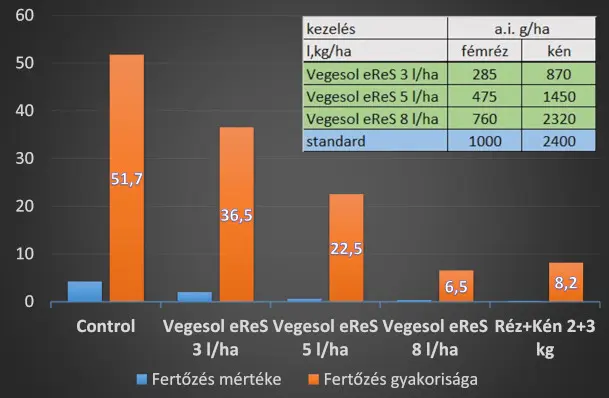
Figure 1. Efficacy of Vegesol eReS against apple scab based on symptom severity and incidence following three early-spring treatments, evaluated on leaf symptoms (early April assessment, 2017, Romania) – source: BVN Növényvédő Kft.
As the first element of a long-lasting apple scab control strategy, we recommend applying Vegesol eReS at its maximum authorized rate of 5 L/ha in pre-flowering treatments. Our copper-containing products make it easier for growers to comply with the 4 kg/ha limit for copper application without having to compromise on the high level of efficacy they are accustomed to.
Vegesol eReS is available without restriction and is also approved for use in organic production.
Powdery mildew control begins with pruning every year, as terminal buds are frequently infected. Primary infection originating from these buds can be difficult to stop, and conidia begin to disperse as early as the green bud stage. The objective is to stop conidia formation at primary infection sources and prevent secondary infection. Systemic active substances should also be used, particularly during the bud stage and after flowering, but sulfur also provides excellent efficacy and forms an integral part of the control programme.
If only sulfur is available, shorter spray intervals are required and the residual activity of the product becomes a particularly important factor. The same principle mentioned above also applies to sulfur: as a contact fungicidal active substance, it must be present where and when the fungus attacks. This can only be achieved if the applied dose is not washed from the plant surface by the first rainfall or morning dew.
In such situations, Vegesol eReS stands out from competing sulfur-containing fungicides. Its liquid formulation makes dosing and application easier, while most importantly, its sunflower oil content and patented film-forming technology provide the required long-lasting activity. The oil polymerizes in an oxidative environment, preventing the sulfur from being rapidly washed off.
Let's Look at the Practical Results!
In the demonstration trial, three treatments were applied in early spring before flowering to the powdery mildew-susceptible Jonathan apple variety. Increasing application rates of Vegesol eReS resulted in progressively better efficacy.
The maximum authorized application rate of 5 L/ha produced better results than another sulfur-containing product. Vegesol eReS achieved this despite the amount of sulfur applied being only 60% of that used with the competing product. In the untreated control plots, the incidence of shoot infection was close to 100% (Figure 2).
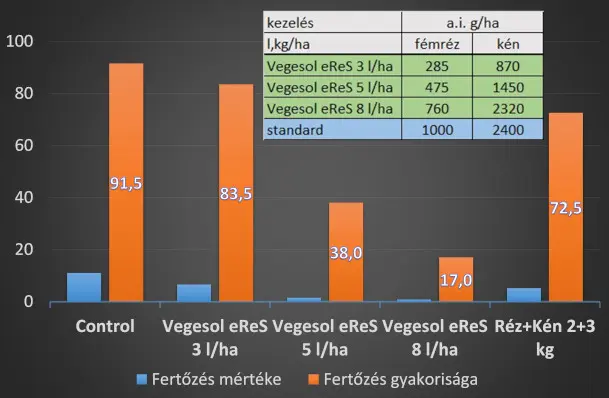
Figure 2. Efficacy of Vegesol eReS against apple powdery mildew based on symptom severity and incidence following three early-spring treatments, evaluated on leaf symptoms (early April assessment, 2017, Romania) – source: BVN Növényvédő Kft.
For controlling the two most important diseases of apple orchards, Vegesol eReS can be used with very good results in early spring, from bud break until flowering, and again during summer after shoot growth has ceased. It can be applied either on its own or, where necessary, in combination with a systemic fungicide.
It is important to highlight that even twice the maximum authorized application rate caused no symptoms of phytotoxicity in the authorization trials.
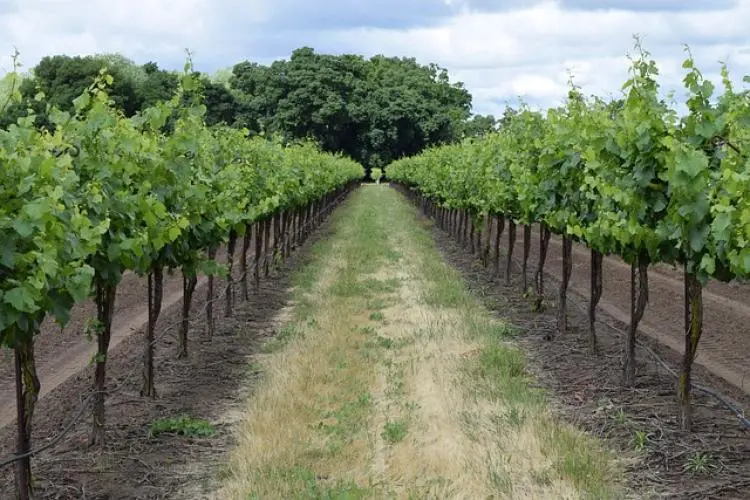
Although grapevine powdery mildew is most commonly seen on grape bunches, its first symptoms can usually be detected on the leaves – photo: pixabay.com
Efficacy of Vegesol eReS Against Grapevine Downy Mildew and Powdery Mildew
In vineyards, Vegesol eReS can provide effective control against both powdery mildew and downy mildew, the two pathogens capable of causing the most significant damage, through repeated applications during the growing season.
Although grapevine powdery mildew is most commonly observed on bunches, its first symptoms can usually be detected on leaves. If sufficient overwintering inoculum is present and infection occurs early, shortly after bud break, epidemic development may follow. The formation of overwintering structures should therefore be prevented as early as late summer.
Chasmothecia forming in August and September can be effectively reduced with oil-formulated sulfur while they are still immature (yellow or brown). Taking the timing of harvest into consideration, Vegesol eReS can also be effective for this purpose. In spring, once the first symptoms are detected, successful control can again be achieved with a contact active substance, making Vegesol eReS a suitable choice at this stage as well.
During periods of intensive shoot growth in grapevines, contact products may provide adequate control when applied at shorter spray intervals (maximum 7 days), while applications can also be adjusted according to weather conditions. The strength of Vegesol eReS lies in its patented formulation: thanks to its special plant oil content, wash-off is slowed down, meaning that only a small proportion of the active substances is removed from the plant surface by morning dew or rainfall. This characteristic – its excellent rainfastness – distinguishes it from competing products.
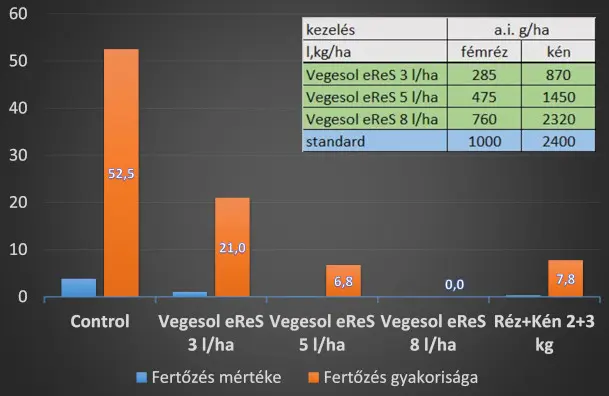
Figure 3. Efficacy of Vegesol eReS against grapevine powdery mildew based on symptom severity and incidence following three spring treatments, evaluated on leaf symptoms (early June assessment, 2017, Romania) – source: BVN Növényvédő Kft.
The product’s rainfastness is also clearly demonstrated in our biological efficacy trials, as this characteristic makes it possible to achieve the same biological efficacy with significantly less active substance than competing products (Figure 1).
Application rates above the authorized rate are required for phytotoxicity testing; even at the highest rate tested, no phytotoxicity was observed in grapevines. Nevertheless, applications should always be carried out with care, and treatment should not be performed at air temperatures above 25 °C.
Epidemic outbreaks of grapevine downy mildew occur less frequently, as disease development depends not only on the quantity of inoculum produced during the previous growing season and its ability to overwinter, but also on favourable weather conditions occurring while grape bunches are susceptible.
The most important source of downy mildew infection is infected leaf debris. If spring night-time temperatures remain above 10 °C and at least 10 mm of rainfall occurs, the overwintering spores of downy mildew begin to develop and reach the leaves closest to the soil, where they form germ tubes and penetrate through the stomata.
Crop protection measures should prevent germinating spores from penetrating the leaf blade. If the spores encounter a fungicide on the plant surface, penetration can be prevented before infection becomes established, eliminating the need to subsequently inhibit sporulation in oil spots with a systemic product. Thanks to the excellent rainfastness of Vegesol eReS, the product remains on the plant surface for an extended period and protects the crop against downy mildew infection. Because wet weather is essential for downy mildew germination, rainfastness should be an important consideration when selecting a product under such conditions.
The formulation advantage of Vegesol eReS makes it possible to achieve the same biological efficacy using significantly less active substance than competing products (Figure 2). Consequently, treatment with the product places a lower metallic copper load on the plantation, while the permitted copper limit of 4 kg/ha is only reached after repeated applications (8×).
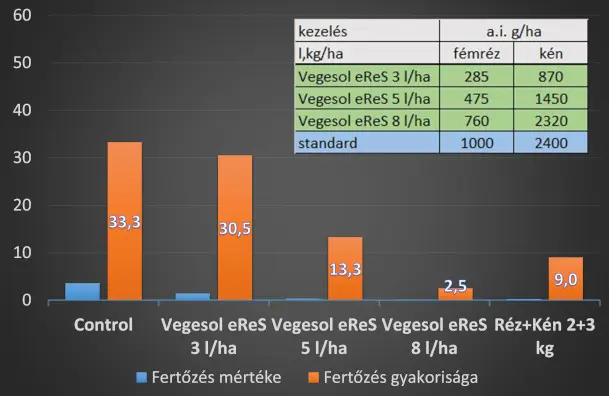
Figure 4. Efficacy of Vegesol eReS against grapevine downy mildew based on symptom severity and incidence following three spring treatments, evaluated on leaf symptoms (early June assessment, 2017, Romania) – source: BVN Növényvédő Kft.
Based on the results of numerous efficacy trials, we can confidently state that the sulfur content of Vegesol eReS also contributes to its efficacy against downy mildew: sulfur acts as a synergist, enhancing the overall effect against the disease.
Figure 1. Efficacy of Vegesol eReS against apple scab based on symptom severity and incidence following three pre-flowering treatments, evaluated on leaf symptoms (early April assessment, 2017, Romania).
As the first element of a long-lasting apple scab control strategy, we recommend applying Vegesol eReS at its maximum authorized rate during pre-flowering treatments. This effective preventive treatment provides a strong foundation for the systemic products to be used during the period of intensive growth after flowering. Once ascospore release has ceased and the period of conidial infection begins, contact products alone are sufficient during the summer. Vegesol eReS, with its two active substances, is also an excellent choice at this stage.
Powdery mildew control begins with pruning every year, as terminal buds are frequently infected. Primary infection originating from these buds can be difficult to stop, and conidia begin to disperse as early as the green bud stage. The objective is to stop conidia formation at primary infection sources and prevent secondary infection. Systemic active substances should also be used, particularly during the bud stage and after flowering, but sulfur also provides excellent efficacy and forms an integral part of the control programme. If only sulfur is available, shorter spray intervals are required and the residual activity of the product becomes a particularly important factor. The same principle mentioned above also applies to sulfur: as a contact fungicidal active substance, it must be present where and when the fungus attacks. This can only be achieved if the applied dose is not washed from the plant surface by the first rainfall or morning dew.
In such situations, Vegesol eReS stands out from competing sulfur-containing fungicides. Its liquid formulation makes dosing and application easier, while most importantly, its plant oil content and patented film-forming technology provide the required long-lasting activity. The oil polymerizes in an oxidative environment, preventing the sulfur from being rapidly washed off.
In the demonstration trial, three treatments were applied before flowering to the powdery mildew-susceptible Jonathan apple variety. Increasing application rates of Vegesol eReS resulted in progressively better efficacy. The authorized application rate produced better results than another sulfur-containing product. Vegesol eReS achieved this despite the amount of sulfur applied being only 60% of that used with the competing product. In the untreated control plots, the incidence of shoot infection was close to 100% (Figure 2).
Figure 2. Efficacy of Vegesol eReS against apple powdery mildew based on symptom severity and incidence following three early-spring treatments, evaluated on leaf symptoms (early April assessment, 2017, Romania)
It is therefore important to highlight that even twice the maximum authorized application rate caused no symptoms of phytotoxicity in the authorization trials. Reducing environmental impact is one of the most important objectives in modern agriculture. With this in mind, we confidently recommend BVN’s oil-based products to growers, particularly for use during the growing season. Our copper-containing products make it easier for growers to comply with the 4 kg/ha limit for copper application without having to compromise on the high level of efficacy they are accustomed to.
All package sizes of Vegesol eReS are available without restriction and are also approved for use in organic production.