

Vegesol R
Liquid spray for controlling fungal and bacterial diseases
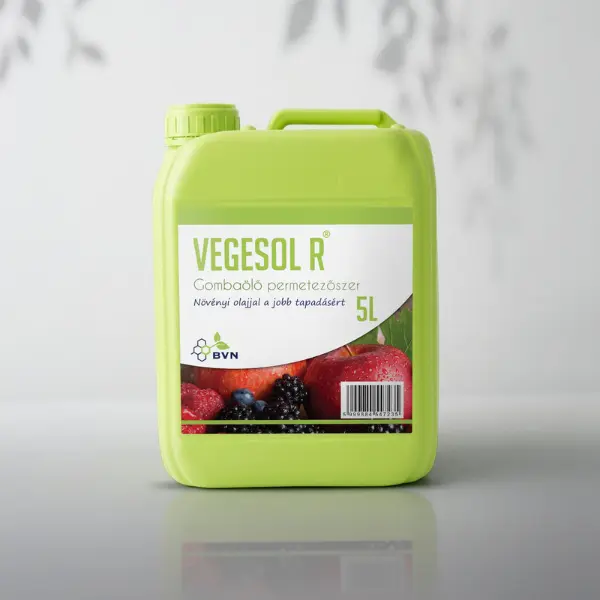
Everything you need to know in one place
Product Details
Active ingredient content: 300 g/l copper(II) hydroxide (24 ± 1.5 m/m%), copper metal equivalent: 195 g/l
Additional ingredient: 250 g/l sunflower oil (20.0 m/m%)
Marketing category: III.
Hazard to aquatic organisms: highly hazardous.
Hazard to bees: not subject to labeling requirements.
Fire hazard classification: not subject to labeling requirements.
Shelf life: Retains its physical and chemical properties for at least two years under normal storage conditions. Shelf life guaranteed by the manufacturer: 3 years
Packaging volumes: 0.2; 0.5; 1; 2.5; 5; 10; 20; 25; 1000 liters
Application
Vegesol R is a copper-containing contact plant protection product that can be used to control a wide range of fungal and bacterial plant diseases.
For home garden spraying, use 30–40 ml per 10 L of water for crop treatment
Grapes – against downy mildew and powdery mildew, the product can be applied at a dose of 2.0–3.0 L/ha, with a spray volume of 800–1,000 L/ha.
Gooseberries, red and black currants – against leaf spot caused by Drepanopeza, the product can be applied at a dose of 3.0 L/ha, with a spray volume of 500–800 L/ha.
Raspberries – against canker diseases, the product can be applied at a dose of 3.0 l/ha, applied with a spray volume of 500–800 l/ha.
Tomatoes – To control late blight, Alternaria, bacterial leaf spot, and fruit rot, the product can be applied at a rate of 2.0–4.0 L/ha with a spray volume of 800 L/ha.
Peas – Against downy mildew, ascochytosis, and bacterial diseases, the product can be applied at a dose of 2.5–3.0 L/ha, with a spray volume of 400–600 L/ha.
Onions – To control downy mildew, Alternaria leaf blight, and bacterial diseases, the product can be applied at a rate of 2.0–4.0 L/ha, with a spray volume of 400–600 L/ha.
Potatoes – To control late blight and Alternaria leaf spot, the product can be applied at a dose of 2.0–4.0 L/ha, with a spray volume of 400–600 L/ha.
Stone fruits – against bacterial and fungal canker, leaf spot, tafrina, and apiognomonium, the product can be applied at a dose of 3.0 l/ha, with a spray volume of 800–1,500 l/ha.
Pome fruits – to control scab, as well as bacterial and fungal branch dieback—the product can be applied at a dose of 2.0–3.0 L/ha, with a spray volume of 800–1,000 L/ha. Against fire blight, the recommended dose is 3.0 L/ha, applied with a spray volume of 800–1,500 L/ha.
Peaches – To control bacterial and fungal branch dieback, leaf spot, and peach leaf curl (tafrina), the product can be applied at a dose of 2.0–3.0 L/ha, with a spray volume of 800–1,000 L/ha, until budbreak. Until flowering, the recommended dose is 3.0 L/ha, applied with 800–1,000 L/ha of spray volume.
Bell peppers – To control bacterial leaf and fruit diseases, the product can be applied at a dose of 3.0–5.0 l/ha, with a spray volume of 500–800 l/ha.
Aerial application: not permitted
Occupational Safety
In the event of poisoning, an allergic reaction, or suspicion thereof, work must be stopped immediately; after providing first aid on site (see: copper poisoning), medical care at a healthcare facility must be arranged.
Occupational health waiting period: 0 days
First Aid
If the product gets into the eyes, rinse the eyes immediately with plenty of water for at least 15–20 minutes.
If swallowed, and if the victim is conscious, rinse the mouth with water, give one or two glasses of water to drink, and seek medical attention.
Treatment: symptomatic and supportive care. Do not induce vomiting!
Antidote: CaNa₂-EDTA (IV)
Food safety waiting periods:
- grapes, onions, stone fruits: 21 days
- pome fruits: 10 days
- tomatoes, peas, potatoes, bell peppers: 7 days
- berries: 5 days
Documents
Science Behind Effective Solutions
In our in-house laboratory, we continuously develop and test our products to ensure the highest standards of efficacy and safety.